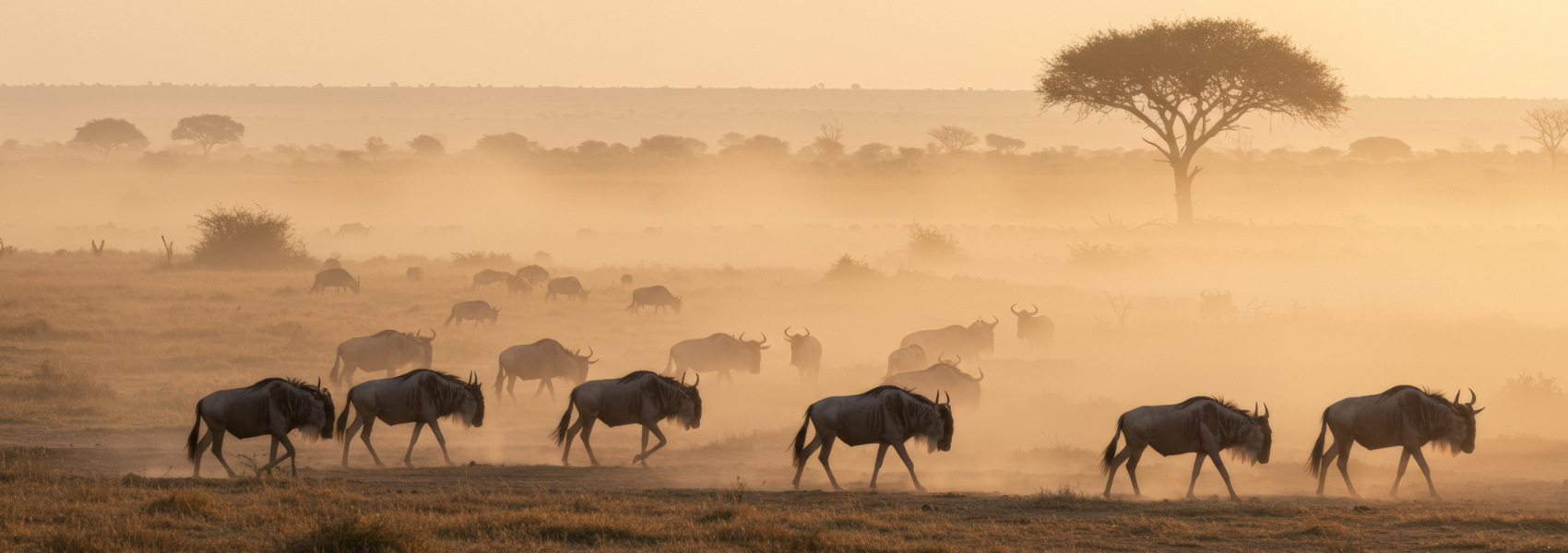
Our Guide to the Great Migration in Tanzania
Cultivating your travel bucket list? You’ve come to the right place. The Great Migration in Tanzania is one of the most wondrous wildlife spectacles in the world, drawing millions of wildebeest (and almost as many visitors) to Tanzania at several points throughout the year. But when is the best time to travel? What are you in with a chance of seeing? And just how quickly can a wildebeest calf run with the herd? With the help of our Tanzania specialist, Jamie, we’ll answer all these questions and more in our guide to the Great Migration in Tanzania...
- What is the Great Migration?
- Why does it take place?
- Where in Tanzania does it take place?
- When is the best time to see Tanzania’s Great Migration?
- How can it be paired with other wildlife watching?
- Why should you book with us?
What is the Great Migration?
In short: the Great Migration is the largest movement of animals on the planet. It’s so large that it can even be seen from space (although we'd recommend sticking with Tanzania).
Also known as ‘the greatest show on Earth,’ this mass movement of mammals sees over one million wildebeest and 300,000 zebra, topi and other gazelle species travelling in a constant cycle through the Serengeti-Mara ecosystem. Each animal (assuming it evades prowling predators) will cover 500-600 miles on its individual journey along well-trodden migration routes. Safe to say, they’re getting their steps in.

Image by Harry Collins / stock.adobe.com
Why does it take place?
The wildebeest aren’t simply in search of a change of scene – or exercise, for that matter – their journey is actually linked to a primal search for fresh grass and water. Guided by a crucial combo of survival instincts and weather cues, the herd follow the rains in search of new grass growth.
Some experts also believe the wildebeest react to other weather events such as thunder and lightning (although this theory, despite being incredibly cool, has no scientific backing at the moment).

Image by simoneemanphoto / stock.adobe.com
Where in Tanzania does it take place?
Starting in the south of the Serengeti – often spilling over into the Ndutu region just beyond the edges of the park – the Great Migration works its way up to the Kenyan border, where the wildebeest embark on their dramatic (and sometimes ill-fated) crossing of the Mara River.
After charging through into Kenya, those who have managed to avoid a gator-grabbing then double back on themselves to journey south towards the wide-open grasslands of Tanzania’s Serengeti. So, even though the Great Migration spans two countries, the animals spend most of their time in Tanzania.

Image by Mongkolchon / stock.adobe.com
When is the best time to see Tanzania’s Great Migration?
Unfortunately (or very fortunately, depending on how you look at it), there’s no solid answer for when the best time to see the Great Migration in Tanzania is. While the river crossings – which occur between June and August – often take the spotlight, our expert Jamie suggests that they might not be everyone’s cup of tea, since they’re quite brutal and incredibly busy.
If you are keen to see the circle of life, Jamie recommends calving season (December to March) instead, during which an estimated 500,000 calves are born, drawing a wide array of predators, including lions, cheetahs and leopards. Thankfully, wildebeest calves are on their feet in around five minutes and running alongside their mothers in a quarter of an hour, so the fight for survival isn’t quite as unfair as it sounds.

Image by Un cercle
How can it be paired with other wildlife watching?
Of course, Tanzania is a vast and varied country (the largest in East Africa), so the Great Migration is far from all it has to offer. To pair your wildebeest viewing with another form of wildlife watching, Jamie suggests travelling between November and April, when fabulous flocks of migratory birds begin to arrive.
Travelling at this time also pairs well with the northern parts of the country, such as Lake Manyara (famed for its tree-climbing lions), Lake Natron and Tarangire National Park. There’s also the lesser-visited, but equally enticing south, where the Nyere and Ruaha National Parks offer a wealth of wildlife watching – without the pesky crowds.

Image by Sebastien Burel / Fotolia.com
Why should you book a Great Migration trip with Original Travel?
While we’ve rounded up a gloss of useful information for you here, Jamie’s top tip is that the reality of travelling to see the Great Migration in Tanzania requires more resources than (if we do say so ourselves) a beautifully informative blog.
The wildebeest attract travellers in – rather ironically – a similarly hectic and dense manner to their own movement. Because of this, the parks are incredibly busy during the river crossing and calving seasons. So, to ensure that conservation is the focus of the camps and guides you use during your stay, it’s best to plan your trip with a tour operator. Well, not just any tour operator… Our full team of Africa specialists can use their expertise to ensure you get the most out of this incredible spectacle, while also looking after the wildlife, environment and community around you.

Image by Coke Bartrina/Nuria Val
Header image by STORYTELLER VISUALS / stock.adobe.com
Why visit Tanzania with Original Travel ?
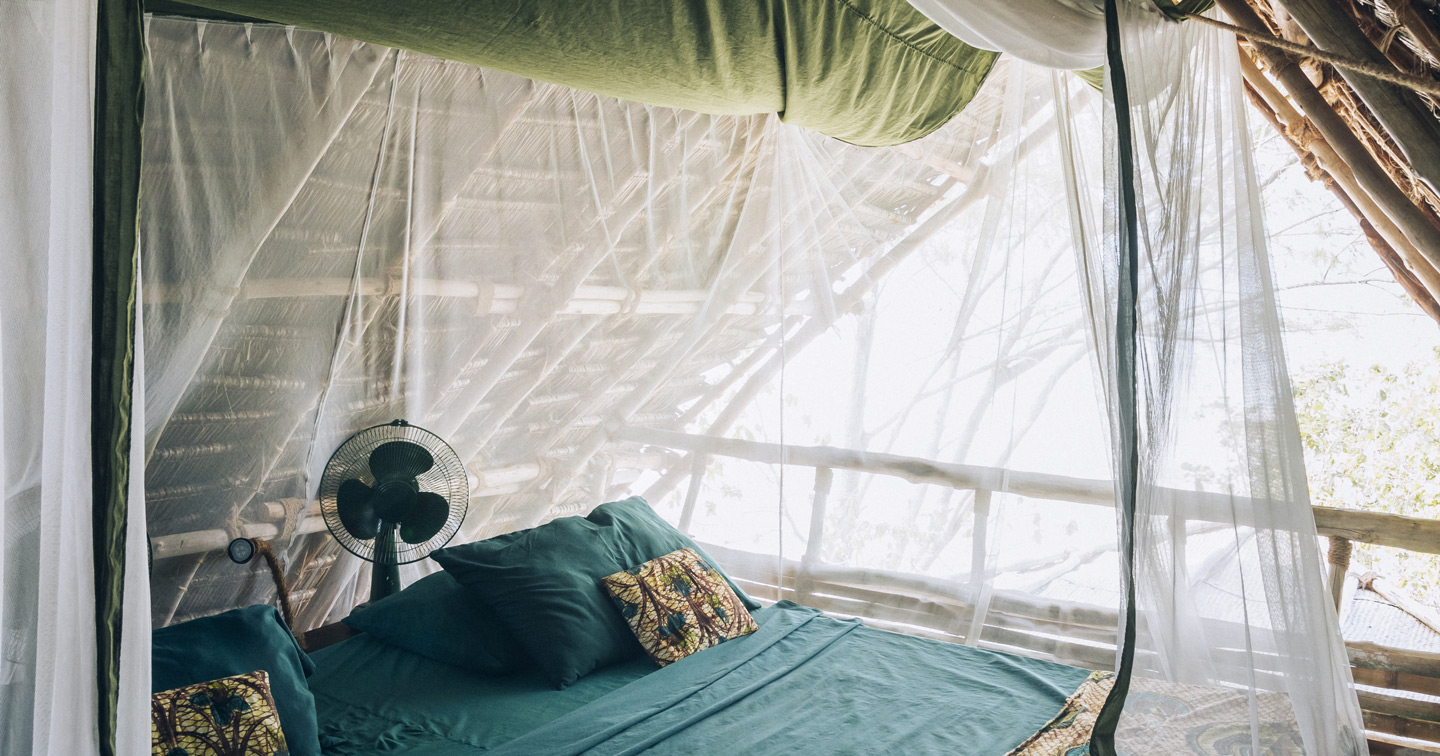
Tanzania's varied landscapes offer the ultimate safari and beach combination for families and honeymooners alike. When it comes to planning your holiday, our consultants will perfectly match your needs to the best-suited parks and activities, offering vetted properties ranging from traditional camps to boutique hotels. Be it an intimate bush dinner in the Serengeti or a private dhow charter and sunset snorkel in Zanzibar, everything is bespoke. In-country, our Concierges offer more insider advice, while our terrific guides, who expertly track wildlife and avoid crowds, enhance every safari.
Enquire nowA few of the benefits of travelling with us to Tanzania
- Our local Concierges
- The Original Travel app
- Wi-Fi router and e-Sim
- Destination Dossier
- 24-hour helpline
- Expert guides
- 100% carbon absorption
You might also like
Practical advice and inspiration for your next trip
Just Back: Jamie’s Research Trip to Tanzania and Zanzibar
On a recent research trip to Tanzania and Zanzibar, our Africa specialist, Jamie, ventured to the regions’ most scenic safari hotspots. She ventured off-road through the Ndutu plains, enjoyed night-time game drives, witnessed a prowling lion pride and decompressed in the beautiful Baraza spa. It was also a trip of firsts: Jamie savoured traditional green banana soup and visited Africa’s only all-female safari camp.
2nd June 2025 - Tanzania Travel Tips
Best Safaris in Tanzania
With animal antics and diverse ecosystems galore, Tanzania is blessed with a plethora of desirable safari spots. This beautiful nation provides everything you’d want from a safari holiday, whether you’re a seasoned safari-goer or an eager first-timer. And with 22 national parks to choose from, you’re spoilt for choice. Each has distinct draws, ample game viewing and stunning scenery, so where do you go?
12th April 2024 - Tanzania Safari & Wildlife
Our Top Five Luxury Safari Lodges in Tanzania
When you think of luxury African safaris, Tanzania deserves to be up there. With more than a third of the country protected, as well as being home to the continent’s highest mountain, its greatest migration and share of its two biggest lakes (Victoria and Tanganyika), Tanzania has a lot going for it – especially in the luxury safari lodge department. While the term 'luxury' can be defined in myriad ways - you may consider it to be opulent gold taps and marble bathrooms or small,
21st February 2024 - Tanzania Safari & Wildlife